
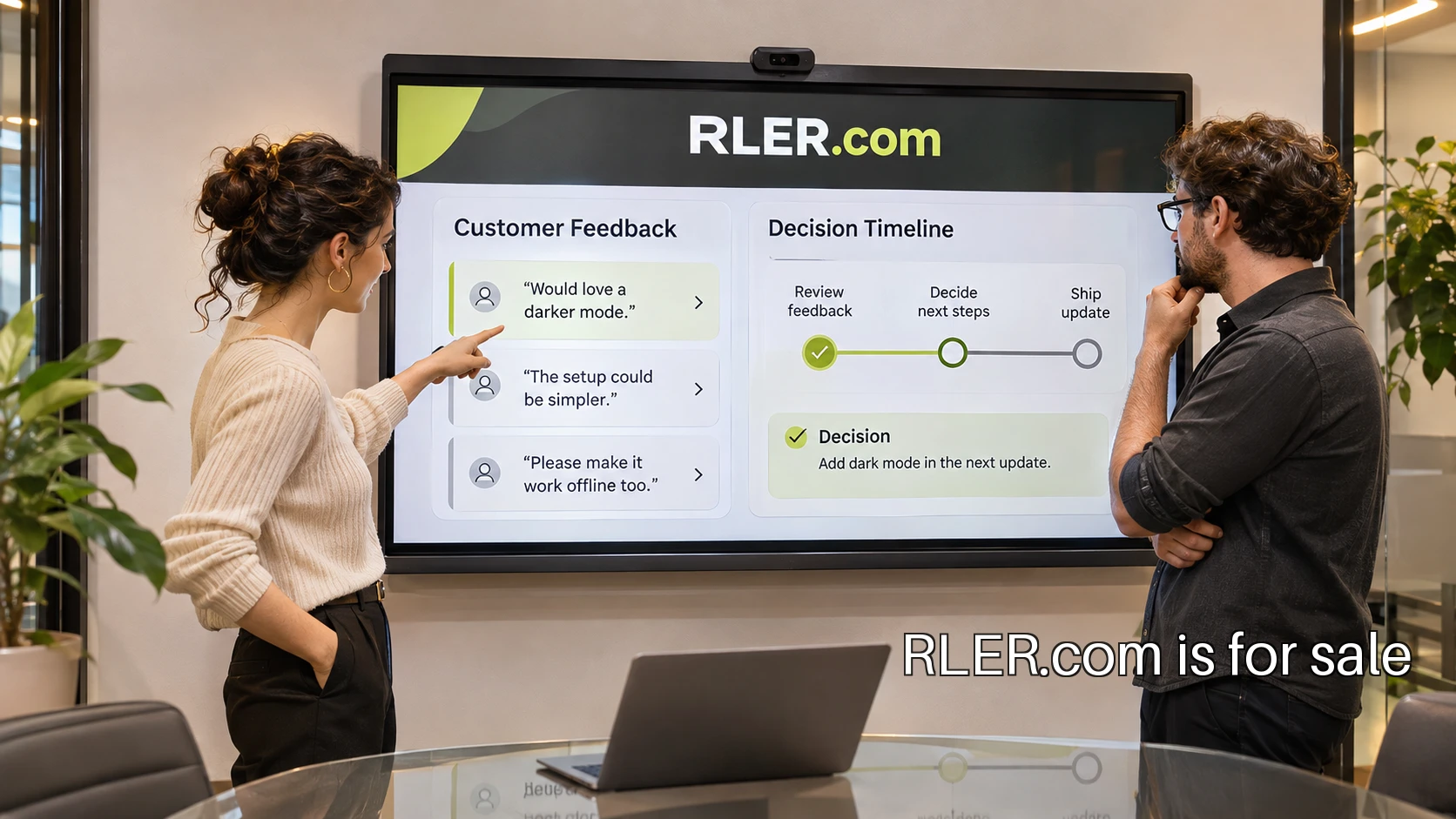
Give a request a decision trail
A product feedback library would connect customer requests to the decisions a team makes about them. Its first buyer could be a product lead who receives feedback through support conversations, sales notes and interviews. Under RLER, that founder could build a clear place for product decisions and the customer evidence behind them. The first useful outcome would be a closed loop, rather than a larger pile of requests.
This is an illustrative business direction. Imagine a customer asking for recurring exports. Support records the request, a product lead links it to a broader reporting problem, and the team chooses a smaller improvement first. A useful library would preserve that reasoning and tell the person responsible for the customer relationship what can be shared. The request would remain connected to the outcome even when the answer is not the feature originally suggested.
Separate what happened from what was proposed
A feedback record should distinguish the customer's situation, the obstacle and their suggested solution. A request for a dashboard might come from difficulty finding yesterday's failed jobs. Those are related facts, but they are not interchangeable. The product lead needs the underlying job before comparing possible solutions. The library could make that distinction visible with a short evidence note and a separate proposed change.
Each record would include where the evidence came from, when it was collected and who can access it. Customer messages can contain sensitive information. The founder should make it easy to store a concise, permitted summary instead of copying a full conversation by default. A source link can preserve context for authorized colleagues while the decision record contains only what the broader team needs.
Make the decision a first-class record
The decision record could explain the problem considered, the options reviewed, the current choice and the reason for revisiting it. It would link several feedback items without reducing them to a vote total. Ten similar requests may still describe different use cases. A product lead should be able to inspect the evidence and state why the team selected one approach.
GitHub's project documentation shows how custom fields and multiple views can organize work around existing records. For this concept, a request view and a decision view would serve different jobs. Support needs to find the customer's item. Product needs to compare the evidence for a choice. Both should lead to the same current decision rather than two conflicting summaries.
Close the loop with care
A decision can be accepted, declined, deferred or superseded. The product should ask who owns the follow-up and what can be communicated. If a request is deferred, the record should say what would justify another review. A vague later status leaves the support team with nothing useful to tell the customer. An explicit condition gives them a clear explanation and a way to recognise new evidence.
Notifications should follow an intentional rule. The colleague who submitted feedback may need a message when a decision changes, while another observer only needs a weekly digest. Before adding automatic customer messages, the founder should test internal review and approval. A library should help a team communicate a considered answer, with the responsible person still able to check the wording.
Start with the last declined request
A credible path to the first buyers is a short interview about a request the team recently chose not to build. Ask where the evidence lived, who made the choice and whether the customer received an explanation. This avoids an abstract discussion about ideal feedback systems. A real decision reveals missing context, competing priorities and the places where the current process already works.
The first offer might include a shared library, a decision log and a small number of source connections. A founder would need reliable search, an activity history and deliberate access controls before adding elaborate scoring. The product should let a team export its decisions with their evidence links. Customers are entrusting the tool with product reasoning they may need long after a single feature ships.
Resist a score that pretends to decide
A weighted priority score can be useful as a prompt for discussion, but it should not erase uncertainty. If three estimates all came from one sales conversation, a total does not create three independent pieces of evidence. The interface could show the inputs and their source dates beside the score. A product lead can then explain a choice with the supporting material in view.
Use plain labels for those inputs. W3C's forms tutorial explains grouping, instructions and notifications, all relevant when several people contribute to a record. A contributor should understand whether they are adding evidence, proposing a solution or recording an approved decision. Clear control names help keep those actions distinct.
Test a complete closure loop
Take one sanitized request and trace it from intake to the final response. Include a second request that initially looks similar but has a different underlying job. Ask a product lead to connect the evidence, record a choice and prepare a follow-up for support. The prototype succeeds when the next colleague can reconstruct the reasoning without another meeting.
RLER gives this product a compact identity that can appear on the library, the decision record and the shared follow-up. The founder can begin with the evidence loop and develop the product around actual team decisions. To discuss acquiring RLER.com for that plan, send a price inquiry with the intended use.